
Your Discord Server Is Not a Message Counter
Message volume tells you how loud last week was, not whether your community is alive. Retention cohorts do. Here is how to read them, what each shape means, and the two numbers worth acting on.

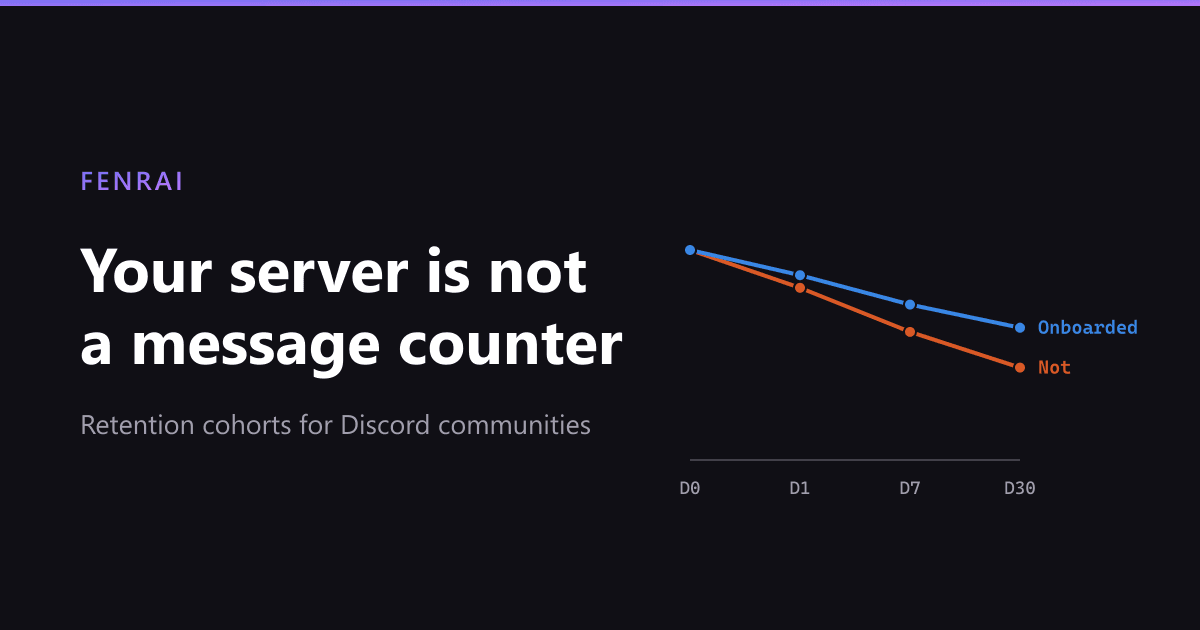
Every Discord analytics dashboard opens with the same number: messages this week, and an arrow next to it. It feels like a health check. It is not one.
Message volume moves for reasons that have nothing to do with whether your community is working. A game update, a drama thread, one argument in general, a raid: all of them spike the chart. Meanwhile a server can post the same twelve thousand messages a month for a year while the same forty people talk and everyone else leaves quietly. The line is flat. The community is dying.
The question underneath is different, and it is answerable: of the people who arrived, how many are still here, and how many are still talking?
Cohorts, not totals
A cohort is everyone who joined in the same week. You measure each cohort at fixed distances from its own start, not from today. Day 1, day 7, day 30.
That framing does two things a running total cannot.
It separates growth from retention. A server adding 200 members a week and losing 190 looks identical on a member-count chart to a server adding 20 and losing 10. Cohorts pull those apart immediately.
It dates your changes. If you rewrote your welcome flow in March, the March cohorts either bend or they do not. A total tells you the server got busier; a cohort tells you whether the thing you did worked.
Two lines, not one
Split every cohort into two readings:
- Stayed: the share still in the server at that day marker.
- Talked: the share who posted at least once on or after that day.
The gap between them is the whole story. Someone who stayed but never talks is a number in your member count and nothing else. They cost you nothing and they give you nothing, and they will leave the first time they clean out their server list.
Four shapes, and what each one means:
| Stayed | Talked | What it is |
|---|---|---|
| High | High | Working. Do less. |
| High | Low | A server people join and forget. An onboarding problem, not a moderation one. |
| Low | Low | People arrive, look around, and leave. Usually a first-impression problem. |
| Low | High | Rare and worth investigating: people engage, then leave anyway. Often a conflict or a burnout cycle. |
The second row is the most common and the most misread. Owners see a healthy member count, assume things are fine, and go looking for ways to get more joins. More joins into a server nobody talks in just makes the second row bigger.
The 24 hour number
There is one metric worth watching daily, and it is not messages. It is the share of joiners who leave within 24 hours.
It is a clean signal because it has exactly two causes, and they are easy to tell apart.
If it spikes and lines up with your moderation log, it was a raid: accounts joined, got caught or got bored, and left. Nothing to fix in your onboarding.
If it spikes and your moderation log is quiet, people are arriving, looking at your server, and deciding against it within a day. That is a first-impression problem: your landing channel, your rules wall, your verification step, or the fact that the first thing a new member sees is a channel list of forty items and no idea where to start.
A high steady rate is worse than a spike, because there is no incident to blame it on.
Who to talk to
The other list worth keeping is people who used to post here, are still in the server, and have said nothing for two weeks.
These are the most reachable people you have. They already decided your server was worth joining and worth talking in. Something changed: the friend they came for left, the channel they lived in died, a thread went badly. A single mention or a "we changed X, come look" is a much cheaper win than another round of promotion.
Two rules for that list. Sort it by how much they used to contribute, because a member who posted 900 times and stopped is a different event from one who posted 6 times and stopped. And leave out people who never posted, because they are a separate problem and mixing them in buries the ones you can still reach.
Channels die before servers do
Server-level activity hides channel-level rot. A server usually does not go quiet all at once: it collapses inward, channel by channel, until everything happens in general and the other thirty channels are archives nobody admits to.
Compare each channel's second half of the window against its first half. A channel down sixty percent while the server is flat did not lose its traffic, it lost it to somewhere else. That is worth knowing before you decide to add another channel.
Ignore percentage changes on channels with almost no traffic. Two messages becoming five is not a 150 percent increase in anything.
What this looks like in Fenrai
All of the above is what the Overview in the Fenrai dashboard shows: retention by joining week with the stayed and talked columns side by side, the 24 hour leave rate, the channel trend, and the list of members who went quiet.
Two implementation details worth knowing, because they change how you read it.
A cohort marker only counts members whose marker has already passed. This week's joiners cannot have a 30 day number yet, so the cell reads "not yet" rather than zero. Dashboards that fill those with zeroes make every healthy server look like it is collapsing at the right edge of the chart.
Nothing is written per message. Counters accumulate in memory and are written out once a minute, so a server sending ten thousand messages an hour costs the same as one sending ten. It also means counting starts when you switch it on: Discord does not hand out the history needed to backfill it, and any tool claiming otherwise is reconstructing it from guesses.
The short version
Track messages if you like. Just do not mistake them for a health check. The two numbers that actually tell you whether your community is working are the share of each joining week still talking a month later, and the share leaving within a day of arriving. Everything else is volume.
More Articles
How to Stop Scam Links in Your Discord Server (2026)
Scam spam no longer comes from throwaway alts, it comes from trusted members whose accounts were stolen. Here is the layered setup that actually stops it: AutoMod, server settings, behavioural rules and the cleanup afterwards.
July 31, 2026
Discord Server Tags: How They Work and What They Actually Do for Growth
A four-character tag next to your members' names is the closest thing Discord has to organic advertising. Here is what it costs, how to set it up, and the uncomfortable reason it works for some servers and does nothing for others.
August 8, 2026